
How Attackers Hijack Sessions After MFA
MFA secures the login. AiTM (Adversary-in-the-Middle) proxies target what happens after — intercepting the authenticated session token before it reaches your user. No second factor is needed for replay.
The Misconception
“We enforce MFA on everything, so even compromised credentials are useless to an attacker.”
Anatomy of the Blind Spot
What MFA Protects Against — and Where It Stops
MFA adds a second factor at the point of login. That's essential for stopping credential reuse. But the authenticated session that follows — represented by a token or cookie — has no MFA protection at all.
What MFA Does Well
- Blocks credential stuffing and brute-force attacks
- Prevents replay of stolen username/password pairs
- Adds a second factor that must be satisfied
- Significantly raises the bar for basic account takeover
Where MFA Stops
- Cannot protect the session token issued after successful authentication
- AiTM proxies intercept cookies post-login — MFA already completed
- Stolen session tokens are replayed without triggering any MFA prompt
- Toolkits like EvilGinx2 and EvilProxy automate session interception at scale
- No visibility into whether a session originated through a proxy
MFA is necessary but insufficient. It protects the authentication step while leaving the session layer — the token that represents the authenticated identity — completely unprotected from interception.
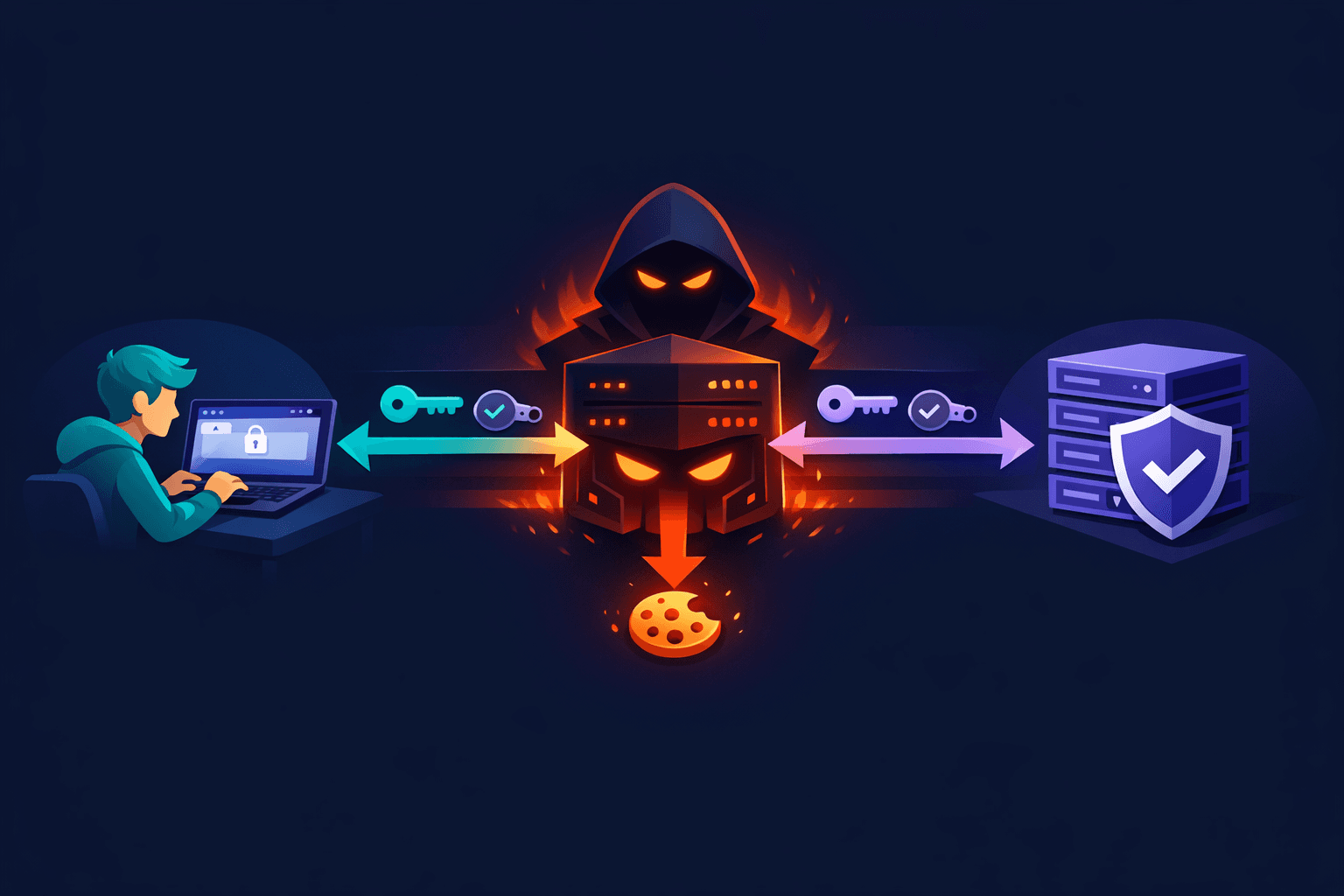
AiTM proxies relay the full login flow transparently — the session token is intercepted after MFA succeeds.
The Attacker's Playbook
How AiTM Proxies Intercept Authenticated Sessions
A reverse proxy sits between the user and the real server, transparently relaying the entire login flow. MFA completes successfully — then the session token is captured.
Deploy a Proxy on a Lookalike Domain
The attacker registers a convincing domain and deploys AiTM tooling (e.g., EvilGinx2, EvilProxy). This creates a transparent reverse proxy between the victim and your real login page.
Direct the Victim to the Proxy
A link via email, SMS, search ad, or social media sends the user to the lookalike domain. The page looks identical to your real login — because it IS your real login, proxied through the attacker's infrastructure.
Authentication Completes Normally
The victim enters credentials and completes MFA as usual. Every input is relayed to your real server through the proxy. From the server's perspective, this is a normal, successful login.
Session Token Intercepted
After MFA succeeds, your server issues a session cookie. The proxy captures this token before passing it to the victim. The user is now logged in — and so is the attacker.
Session Replayed Without MFA
The attacker imports the stolen session cookie into their own browser. Full account access — no credentials, no MFA prompt, no anomaly. The session was legitimately authenticated.
Real-World Impact
What Happens After a Session Is Hijacked
A stolen session cookie grants the same access as the legitimate user. No alerts trigger, no failed logins are logged, and MFA is never challenged again.
Silent Account Takeover
The attacker has a valid session — no alerts trigger, no failed login attempts logged, no MFA challenges. Traditional detection mechanisms are blind because the session was legitimately authenticated.
Lateral Movement
Once inside with a valid session, attackers can access connected services, read emails, modify settings, and initiate BEC attacks — all appearing as the legitimate user.
Data Exfiltration
With full session access, sensitive data including emails, documents, and financial records can be exfiltrated before the session expires or the breach is detected.
False Confidence
The presence of MFA creates a false sense of security. IR teams may dismiss the possibility of session hijacking because "MFA was in place," delaying investigation.
The Missing Layer
How DefendDomain Detects AiTM Infrastructure
AiTM attacks depend on external infrastructure — lookalike domains, proxy servers, and rogue SSL certificates. DefendDomain catches this infrastructure during setup, before any session is hijacked.
Layer 1
Domain Monitoring
Detects the lookalike domains that AiTM proxies require. Every AiTM attack needs a convincing URL — DefendDomain catches these registrations and flags domains configured for proxying.
Layer 4
Certificate Monitoring
AiTM proxies need valid SSL certificates to appear legitimate. Layer 4 monitors Certificate Transparency logs in real time, detecting certificates issued for brand-impersonating domains within minutes.
Layer 2
Security Embeds
When your login page is proxied through an AiTM toolkit, embedded markers detect the unauthorised relay instantly — alerting you that your authentication flow is being intercepted.
MFA vs DefendDomain
They're not competitors — they address fundamentally different layers of the attack chain. Here's how they compare.
| Capability | MFA |  DefendDomain DefendDomain |
|---|---|---|
| Protects against | Credential reuse & brute force | Infrastructure-level threats |
| AiTM proxy attacks | Vulnerable (session captured) | Detected (proxy domain + cert flagged) |
| Session cookie theft | No protection after auth | Prevents by catching proxies pre-auth |
| Detection timing | After failed login (if at all) | During attacker infrastructure setup |
| Lookalike domain awareness | None | Continuous monitoring |
| Certificate monitoring | Not applicable | Real-time CT log monitoring |
| Channel coverage | Login flow only | All external attack surfaces |
Bottom line: MFA secures the authentication step. DefendDomain secures the infrastructure layer — catching the proxy domains, rogue certificates, and AiTM toolkits that enable session hijacking before any token is intercepted.
Frequently Asked Questions
Common questions about MFA limitations and AiTM attack detection.
See the Proxy Domains Targeting Your Brand
Request a free assessment and see whether AiTM infrastructure is already targeting your login pages.

Speak with our team
We'll walk you through the platform and show you exactly what AiTM infrastructure is targeting your authentication flows.